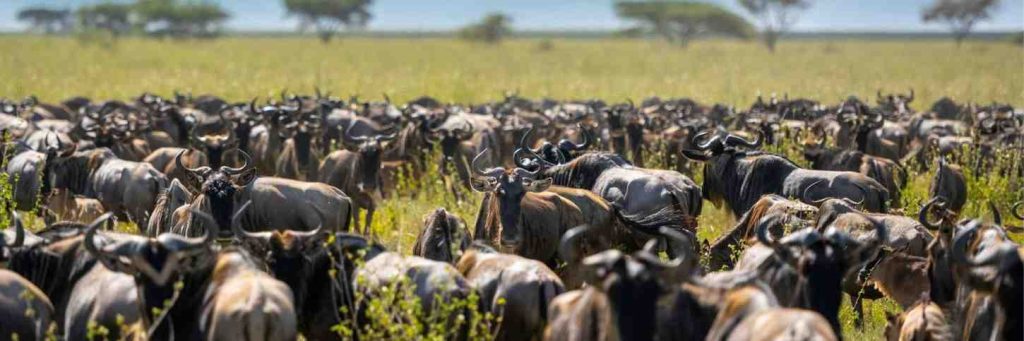
Imagine standing on the golden plains of the Serengeti just before sunrise. The air is cool, the horizon glows with the first hints of dawn, and a deep rumble begins to echo across the landscape. At first, it sounds like distant thunder. Then the ground beneath your feet starts to vibrate. As daylight spreads across the savannah, thousands become hundreds of thousands, and soon more than a million wildebeests emerge from the morning mist. Zebras weave effortlessly through the moving columns, gazelles dart across the grasslands, and predators patiently observe every movement. You are witnessing one of nature’s greatest spectacles—the Great Wildebeest Migration.
Every year, the Serengeti-Mara ecosystem hosts the largest movement of land mammals on Earth. More than 1.5 million wildebeests, accompanied by approximately 400,000 zebras, over 300,000 Thomson’s gazelles, Grant’s gazelles, elands, and numerous other herbivores, travel across northern Tanzania and southern Kenya in a continuous search for fresh grazing and reliable water sources. Together, they complete an extraordinary circular journey of nearly 1,000 kilometres, creating an ecological event so immense that it has become one of the Seven Natural Wonders of Africa.
Yet the Great Wildebeest Migration is far more than a seasonal movement of animals. It is an ancient rhythm that has shaped the Serengeti ecosystem for thousands of years. Every rainfall, every blade of fresh grass, every predator, and every river crossing plays a role in a cycle of life that has remained remarkably unchanged despite the modern world beyond its borders.
For travellers, photographers, wildlife enthusiasts, honeymooners, and families, witnessing the migration is often the fulfilment of a lifelong dream. It offers far more than dramatic river crossings or iconic wildlife photographs. A migration safari allows visitors to experience Africa at its wildest and most authentic, where every game drive unfolds differently and no two days are ever the same.
Whether you hope to witness thousands of calves taking their first steps across the southern plains, watch lions stalk vast herds beneath scattered acacia trees, photograph elephants wandering through golden grasslands, or experience the adrenaline of a Mara River crossing, understanding how the migration works will help you plan an unforgettable safari.
This comprehensive guide explores every stage of the Great Wildebeest Migration in detail, from the science behind the journey to the best months to travel, where to stay, what wildlife you can expect to see, and how to choose the perfect safari itinerary. By the end, you will understand why this remarkable natural phenomenon continues to inspire travellers from around the world and why it deserves a place at the very top of every safari bucket list.
Understanding the Great Wildebeest Migration
The Great Wildebeest Migration is often described as a journey from Tanzania to Kenya and back again. While this description is technically correct, it barely captures the complexity of one of nature’s most sophisticated ecological systems.
Unlike birds that migrate along fixed seasonal routes, wildebeests do not follow a predetermined path marked on an invisible map. Instead, they respond instinctively to environmental conditions, particularly rainfall. Their movement depends on where fresh grass emerges after seasonal rains, making each year’s migration unique.
This means there is no official beginning or end to the migration. Instead, it is a continuous cycle that repeats every year, driven by nature rather than a calendar. Weather patterns influence where the herds travel, how quickly they move, and when they cross major rivers. A wetter-than-average season may delay their progress, while prolonged dry conditions can encourage faster movement towards greener grazing grounds.
The migration represents one of the finest examples of how wildlife has adapted to survive in one of Africa’s most dynamic ecosystems. Wildebeests possess an extraordinary ability to detect distant rainfall, allowing them to move towards fresh grazing long before the landscape visibly changes. Scientists continue to study this remarkable behaviour, believing the animals rely on a combination of smell, atmospheric conditions, and deeply ingrained instinct developed over countless generations.
Every movement serves a purpose. Fresh grass provides essential nutrients, especially phosphorus and nitrogen, which are vital for pregnant females and growing calves. Water sustains enormous herds during long journeys across open plains. The continuous movement also prevents overgrazing, allowing vegetation to recover naturally before the animals return months later.
This intricate relationship between rainfall, grass growth, grazing animals, predators, insects, and scavengers has created one of the healthiest and most balanced ecosystems remaining anywhere on Earth.
More Than a Migration: A Living Ecosystem
Although the migration centres on wildebeests, these remarkable animals never travel alone. They share the journey with countless other species, each playing a distinct role in maintaining the ecological balance of the Serengeti.
Zebras usually travel alongside wildebeests because they consume taller, coarser grasses that wildebeests avoid. As zebras graze, they expose shorter, nutrient-rich shoots beneath, creating ideal feeding conditions for the wildebeests that follow behind. This natural partnership allows both species to benefit without competing directly for food.
Gazelles often arrive after both zebras and wildebeests have passed through an area. Their smaller mouths enable them to feed on the youngest and most nutritious shoots emerging from the recently grazed grasslands. Together, these three herbivore species use the landscape efficiently, ensuring that no single area becomes permanently depleted.
Their movement attracts an extraordinary concentration of predators. Lions establish territories near major migration routes, knowing prey will eventually arrive. Cheetahs rely on the open plains to chase gazelles at remarkable speeds exceeding 100 kilometres per hour. Leopards remain hidden within riverine forests and acacia woodlands, waiting patiently for isolated animals to wander close enough for an ambush.
Spotted hyenas follow the migration tirelessly, demonstrating intelligence and endurance that rival many larger predators. Often misunderstood, hyenas are highly skilled hunters capable of bringing down healthy adult wildebeests through coordinated group tactics. Their success contributes significantly to maintaining healthy herbivore populations.
Nile crocodiles represent perhaps the migration’s most feared predators. Some individuals have inhabited the Mara and Grumeti Rivers for decades, growing to enormous sizes while patiently waiting for annual river crossings. During these dramatic events, crocodiles take advantage of confusion and strong currents to capture exhausted animals attempting to reach the opposite bank.
Yet predators are only one part of the story. Vultures circle overhead searching for carcasses, jackals patrol the plains for scraps, dung beetles recycle nutrients into the soil, and countless insects support birds, reptiles, and amphibians throughout the ecosystem. Even death sustains life here. Every animal that falls during the migration contributes nutrients that nourish grasses, trees, and future generations of wildlife.
The Great Wildebeest Migration therefore represents far more than an impressive gathering of animals. It is the heartbeat of the Serengeti, supporting one of the most biologically diverse landscapes on the African continent.
Why the Great Wildebeest Migration Captivates the World
Few wildlife experiences inspire the imagination quite like the Great Wildebeest Migration. Nature documentaries, award-winning photographs, and countless travel stories have introduced millions of people to the dramatic scenes of wildebeests plunging into crocodile-filled rivers. Yet those iconic images reveal only a small part of the experience.
The true magic of the migration lies in its unpredictability.
No guide, scientist, or safari operator can promise exactly what will happen on any particular day. One morning may begin quietly, with scattered herds grazing peacefully beneath the rising sun. By afternoon, thousands of animals may suddenly gather at a riverbank, hesitating for hours before one brave wildebeest leaps into the water and triggers a breathtaking mass crossing. Within minutes, calm transforms into organised chaos as dust, splashing water, alarm calls, and thundering hooves create one of the most dramatic wildlife spectacles on Earth.
On another day, your guide may notice subtle signs that many visitors overlook—a lioness crouching low in golden grass, zebra alarm calls echoing across the plains, or vultures circling high overhead. These clues often signal that an extraordinary wildlife encounter is about to unfold. Such moments cannot be scheduled, making every game drive feel like a genuine expedition rather than a predictable tour.
The migration also unfolds across landscapes of exceptional beauty. Endless golden plains stretch to the horizon, broken only by scattered acacia trees, rocky kopjes, winding rivers, and dramatic skies that change colour throughout the day. Sunrises paint the savannah in warm shades of amber and gold, while evenings end with fiery sunsets that seem almost unreal. These landscapes provide the perfect backdrop for one of the greatest wildlife experiences on the planet.
For photographers, every hour presents fresh opportunities. The soft light of dawn highlights dew-covered grasslands as giraffes move gracefully across the horizon. Midday brings dramatic predator encounters and vibrant wildlife activity, while golden hour bathes the plains in rich, warm light ideal for capturing silhouettes of elephants, wildebeests, or acacia trees against the African sky.
Perhaps most importantly, the migration reminds us that truly wild places still exist. In a rapidly changing world, the Serengeti remains one of the few landscapes where ancient natural processes continue largely uninterrupted. Watching millions of animals follow instincts that have guided them for thousands of years offers a rare perspective on the resilience, beauty, and interconnectedness of the natural world.
For many travellers, that feeling becomes the most memorable part of the journey. They return home not only with spectacular photographs but with a profound appreciation for one of Earth’s last great wildernesses.
The Great Wildebeest Migration Month by Month: Where the Herds Are and the Best Time to Visit
One of the most common questions safari travellers ask is, “When is the best time to see the Great Wildebeest Migration?“ While the question seems straightforward, the answer is more nuanced than many people expect.
The truth is that there is no single best month to experience the migration. Every stage of the journey offers something extraordinary, from the arrival of thousands of newborn calves on the southern plains to the dramatic river crossings that have become synonymous with the Great Migration. The ideal time to visit depends entirely on the type of experience you want.
Some travellers dream of witnessing vast herds stretching across the Serengeti as far as the eye can see. Others hope to photograph crocodile attacks during river crossings or watch lion prides stalk vulnerable wildebeests. Families may prefer quieter months with fewer visitors, while photographers often seek softer light, greener landscapes, and more intimate wildlife encounters.
Understanding the migration’s seasonal rhythm allows you to choose the right destination, accommodation, and travel dates. Instead of hoping to be in the right place at the right time, you can plan your safari around the wildlife experiences that matter most to you.
Although rainfall influences the exact timing every year, the migration generally follows a predictable annual cycle across the Serengeti ecosystem.
January: New Beginnings on the Southern Plains
As the short rains replenish the southern Serengeti and the Ndutu Conservation Area, the migration settles across one of the most fertile landscapes in East Africa. The endless grasslands become lush and vibrant, providing the nutrient-rich grazing that pregnant wildebeests need before giving birth.
January is often overlooked in favour of the famous river crossing season, yet experienced safari guides know it marks the beginning of one of the migration’s most rewarding periods.
The herds spread across the southern plains rather than forming the dense columns seen later in the year. This creates spectacular panoramic views, with thousands of wildebeests grazing beneath wide African skies while zebras, gazelles, ostriches, and giraffes share the same landscape.
Predator activity steadily increases during this period. Lions establish territories close to the herds, cheetahs patrol the open plains searching for gazelles, and spotted hyenas remain active both day and night. Wildlife photographers particularly appreciate January because the lush scenery creates vibrant images rarely associated with the dry Serengeti.
Morning game drives often reveal dramatic interactions between predators and prey before temperatures begin to rise. Afternoon drives offer beautiful golden light as wildlife gathers around seasonal water sources.
For visitors seeking fewer crowds, comfortable temperatures, and outstanding wildlife viewing, January is one of the Serengeti’s hidden gems.
February: The Spectacular Calving Season
February is widely regarded as one of the most extraordinary months in the entire migration cycle. During a remarkably short period, approximately half a million wildebeest calves are born across the southern Serengeti and Ndutu plains.
This synchronised birth is one of nature’s greatest survival strategies.
By giving birth within a few weeks, the wildebeest overwhelm predators through sheer numbers. Lions, hyenas, cheetahs, jackals, and leopards cannot possibly hunt every newborn. Although many calves become prey, the vast majority survive because predators simply cannot keep pace with the constant stream of births.
Visitors often witness newborn calves standing within minutes of birth. Within an hour, many are already walking beside their mothers. By the end of the day, they can often keep pace with the moving herd—a remarkable adaptation essential for survival.
The abundance of vulnerable young animals attracts extraordinary predator activity. Lion prides hunt more frequently, cheetahs focus on isolated calves, and hyenas patrol constantly. Every game drive carries the possibility of witnessing remarkable wildlife interactions.
For photographers, February offers unmatched opportunities to capture intimate family behaviour. Mothers gently encourage newborn calves to stand, while protective herds surround vulnerable young animals against potential danger.
The combination of dramatic wildlife encounters, lush landscapes, and exceptional photographic conditions makes February one of the finest months to visit the Serengeti.
March: Growing Calves and Expanding Herds
By March, the southern plains remain alive with activity as young wildebeests grow stronger each day. The calves that struggled to stand only weeks earlier now run confidently alongside their mothers, gradually preparing for the long migration ahead.
The landscape remains beautifully green, although rainfall patterns begin to shift as the season progresses.
Large concentrations of predators continue following the herds, taking advantage of inexperienced young animals that occasionally become separated during movement. Lions are particularly active, while cheetahs thrive in the open grasslands where they can use their incredible speed to pursue smaller antelope.
March also provides outstanding birdwatching opportunities. Migratory birds remain present across the Serengeti, adding remarkable diversity to already exceptional wildlife viewing.
Visitor numbers remain moderate compared to the peak migration season later in the year. This creates a more relaxed safari experience with fewer vehicles around wildlife sightings, allowing guests to spend longer observing natural animal behaviour.
Travellers looking for an authentic safari experience without the busiest crowds often find March an excellent balance between wildlife density and visitor comfort.
April: The Long Rains and the Journey North Begins
April marks a significant transition in the migration.
As the long rains arrive across much of northern Tanzania, the enormous herds gradually begin leaving the southern plains. Fresh grazing emerges farther northwest, encouraging the migration to move towards the central Serengeti.
Although some travellers avoid April because of the increased chance of rain, this month offers several unique advantages.
The Serengeti transforms into a vibrant landscape filled with lush vegetation, dramatic storm clouds, and crystal-clear air after rainfall. Wildlife remains abundant, and photographers often capture some of the year’s most atmospheric images as shafts of sunlight break through towering clouds.
The migrating columns begin forming once again. Instead of scattered grazing groups, visitors increasingly witness long lines of wildebeests stretching across valleys and ridges as the journey gathers momentum.
Accommodation rates may also be lower during this period, providing excellent value for travellers seeking a luxury safari at a more accessible price.
May: Endless Columns Across the Central Serengeti
May showcases one of the migration’s most impressive visual spectacles.
Hundreds of thousands of wildebeests travel in seemingly endless columns through central Serengeti, creating dramatic scenes that few visitors ever forget. The herds move with remarkable purpose, often covering considerable distances as they continue following fresh grazing.
Dust begins replacing the lush greenery of earlier months, particularly towards the end of May, creating the iconic golden Serengeti landscapes featured in countless wildlife documentaries.
Predators remain close behind.
Lion prides frequently position themselves along migration routes, understanding that patient ambushes often produce successful hunts. Hyenas continue following the moving herds, while vultures circle high above searching for opportunities.
The central Serengeti offers excellent year-round wildlife viewing, making May an outstanding month for visitors who want to combine migration sightings with resident wildlife including elephants, giraffes, buffaloes, leopards, and abundant birdlife.
June: The Western Corridor and the First River Crossings
As the dry season strengthens, the migration reaches the Western Corridor of the Serengeti.
This region introduces one of the migration’s defining features: river crossings.
Before reaching the famous Mara River later in the year, many herds encounter the Grumeti River. Although smaller than the Mara, the Grumeti presents significant challenges. Deep channels, steep banks, and resident Nile crocodiles create dramatic obstacles for migrating animals.
Unlike the massive crossings often associated with the Mara River, Grumeti crossings tend to involve smaller groups. This allows visitors to observe the animals’ behaviour more closely as they cautiously assess the safest place to enter the water.
June also marks the beginning of Tanzania’s peak safari season. Cooler temperatures, dry weather, and increasingly concentrated wildlife attract visitors from around the world.
The landscapes remain beautiful, balancing green vegetation with the golden tones that define the dry season.
For many experienced safari enthusiasts, June offers one of the year’s most enjoyable combinations of pleasant weather, excellent wildlife viewing, and moderate visitor numbers before the busiest months arrive.
July to December: Witness the Migration at Its Most Dramatic
As the dry season tightens its grip on the Serengeti, the migration enters the phase that has captured the imagination of wildlife enthusiasts around the world. Vast herds move steadily towards the northern reaches of the Serengeti, where one of nature’s greatest challenges awaits—the Mara River.
Although spectacular wildlife viewing is possible throughout the year, the months between July and October are often regarded as the migration’s most dramatic period. Yet these months are about much more than river crossings. They represent the culmination of months of movement, survival, instinct, and adaptation, where every decision made by the herd carries life-or-death consequences.
Understanding what happens during this period helps travellers appreciate why patience, timing, and experienced guides make such a difference on a Great Wildebeest Migration safari.
July: The Northern Serengeti Comes Alive
By July, the migration has reached the northern Serengeti, where the landscape changes dramatically. Rolling grasslands give way to rocky outcrops, riverine forests, and the winding channels of the Mara River. The scenery feels wilder, more rugged, and perfectly suited to one of Africa’s greatest wildlife spectacles.
The herds do not arrive all at once. Instead, thousands of wildebeests gather gradually along the riverbanks, sometimes remaining in one area for several days before attempting a crossing. To first-time visitors, this hesitation may seem puzzling, but it is one of the migration’s most fascinating behaviours.
Wildebeests instinctively recognise danger. They can smell crocodiles in the water, hear the movement of predators hidden among nearby vegetation, and sense the uncertainty of steep riverbanks. As a result, the animals often gather in enormous numbers, milling around nervously while individual wildebeests move forward, retreat, and call to one another. Hours may pass without a single animal entering the river.
Then, almost without warning, one wildebeest commits.
Within seconds, hundreds—sometimes thousands—follow.
The peaceful riverbank erupts into organised chaos. Hooves pound the earth, dust fills the air, zebras weave through the moving herd, and the river churns beneath the weight of countless animals fighting strong currents to reach the opposite bank.
For safari guests, witnessing this moment is unforgettable. No documentary can fully capture the sound of thousands of hooves, the tension before the first leap, or the overwhelming scale of the crossing as it unfolds just metres away.
August: Peak Mara River Crossing Season
August is widely regarded as one of the best months to experience the Great Wildebeest Migration, largely because river crossings become more frequent and involve exceptionally large herds.
By now, many animals have reached the Mara River, but their journey remains far from over. Crossing the river once does not mean the migration has ended. The herds often move back and forth across the river several times depending on grazing conditions, creating multiple crossing opportunities throughout the season.
This unpredictability is what makes every safari unique.
Some visitors witness several dramatic crossings in a single trip, while others spend hours observing thousands of wildebeests gathering on the riverbank before eventually deciding not to cross that day. Experienced guides understand these patterns and carefully position vehicles where the likelihood of activity is highest, while always respecting wildlife viewing regulations.
The Mara River itself presents numerous dangers.
Powerful currents sweep weaker animals downstream. Steep riverbanks become slippery as thousands of hooves churn the soil into deep mud. Nile crocodiles, some measuring more than five metres in length, remain almost motionless beneath the surface, conserving energy until an opportunity presents itself. Along the surrounding grasslands, lions, leopards, hyenas, and even opportunistic jackals wait for exhausted or injured animals emerging from the water.
Yet despite these risks, the migration continues.
This remarkable determination reflects one simple reality: remaining behind often poses an even greater threat than moving forward. Without fresh grazing, the herds cannot survive.
For photographers, August offers endless opportunities to capture powerful storytelling images—from dramatic action scenes at the river to emotional portraits of exhausted mothers guiding calves safely across.
September: Exceptional Wildlife Viewing with Fewer Crowds
By September, large numbers of wildebeests remain in the northern Serengeti and neighbouring Maasai Mara, although the intense pace of river crossings begins to vary depending on rainfall.
Many experienced safari travellers consider September one of the year’s finest months because it combines outstanding wildlife viewing with slightly fewer visitors than the peak weeks of August.
The dry season has concentrated wildlife around permanent water sources, making game drives exceptionally productive. Elephants gather along riverbanks, buffalo herds roam open plains, giraffes browse among acacia woodlands, and predators remain highly active throughout the region.
Lions frequently position themselves near established migration routes, while leopards become easier to spot within riverine forests where vegetation has thinned during the dry season.
Cheetahs also benefit from the open grasslands, where unobstructed visibility allows them to detect prey over considerable distances before launching remarkable high-speed pursuits.
For visitors seeking an ideal balance between migration activity, predator sightings, and comfortable weather, September consistently ranks among the most rewarding months of the safari calendar.
October: The Dry Season Reaches Its Peak
October represents the final chapter of the northern migration before seasonal rains begin transforming the landscape once again.
By now, grazing pressure has significantly reduced available pasture across many northern regions. Wildlife becomes increasingly concentrated around rivers and remaining green areas, creating excellent game viewing opportunities.
Although river crossings still occur, they become less predictable as some herds begin preparing for the long journey south.
October rewards patient travellers.
Rather than focusing exclusively on dramatic crossings, visitors often enjoy extended wildlife encounters with fewer safari vehicles. Guides have more freedom to position vehicles carefully, allowing guests to observe natural behaviour without feeling rushed.
This month also produces beautiful photography. Dry grasslands glow beneath soft afternoon light, dramatic sunsets become increasingly common, and dust created by moving herds adds atmosphere to landscape images.
For travellers who appreciate quieter safari experiences while still enjoying remarkable wildlife viewing, October offers outstanding value.
November: Following the Rain Back South
With the arrival of the short rains, subtle changes begin reshaping the Serengeti ecosystem.
Fresh grass appears across central and southern Serengeti, triggering the next stage of the migration. Wildebeests gradually leave the north, beginning their long return journey towards the nutrient-rich plains where the cycle first began.
Unlike the dramatic urgency of river crossings, November’s migration unfolds more gently.
The herds spread across wider areas as they travel south, feeding frequently on fresh vegetation created by recent rainfall. The landscape quickly transforms from dusty gold to vibrant shades of green, breathing new life into rivers, woodlands, and open plains.
Birdlife flourishes during this period. Migratory species return, breeding activity increases, and colourful birdlife adds another dimension to every game drive.
November also marks the beginning of the Serengeti’s quieter travel season. Visitors willing to embrace occasional afternoon showers often enjoy excellent wildlife viewing, beautiful scenery, and more exclusive safari experiences.
December: Completing Nature’s Endless Circle
By December, much of the migration has returned to the southern Serengeti and Ndutu region, completing another remarkable chapter in its ancient journey.
Pregnant females once again seek the short-grass plains that provide the minerals and nutrients essential for successful calving. Although the spectacular births of February remain weeks away, anticipation builds as the herds settle across the southern ecosystem.
December combines excellent wildlife viewing with beautiful green landscapes. Resident predators closely monitor the returning herds, knowing another season of abundance lies ahead.
For travellers visiting during the festive season, December offers a wonderful introduction to the migration before the calving season begins. Families, couples, and first-time safari guests often appreciate the comfortable temperatures, vibrant scenery, and impressive concentrations of wildlife spread across the southern plains.
As one annual cycle draws to a close, another quietly begins.
This continuous movement has repeated itself for thousands of years, making the Great Wildebeest Migration not simply an annual event, but one of the world’s last truly timeless natural phenomena.
Choosing the Best Time for Your Great Wildebeest Migration Safari
Rather than asking, “What is the best month to visit?” a better question is, “What experience do I want to have?”
If witnessing dramatic river crossings has always been your dream, the northern Serengeti between July and October offers your best opportunity. During these months, patience often rewards travellers with unforgettable scenes of thousands of wildebeests plunging into the Mara River while crocodiles wait below and predators patrol nearby.
If your passion lies in wildlife photography, the lush landscapes of January through March provide vibrant colours, dramatic skies, newborn animals, and exceptional predator activity. The calving season delivers countless intimate moments that showcase the beginning of life on the African plains.
Travellers seeking fewer crowds and excellent value should consider April, May, or November. These months often provide outstanding wildlife viewing, beautiful scenery, and a more exclusive safari experience while avoiding the busiest travel periods.
Ultimately, there is no wrong time to experience the Great Wildebeest Migration. Each season reveals a different chapter of the story, and each chapter offers moments that remain with visitors long after they return home.
The key to a successful safari is not simply choosing the right month. It is choosing the right itinerary, experienced guides who understand the movement of the herds, and accommodations located close to the migration’s expected route. With thoughtful planning, every stage of this extraordinary journey has the potential to become the safari experience of a lifetime.
Where to See the Great Wildebeest Migration: Choosing the Best Location for Your Safari
One of the biggest misconceptions about the Great Wildebeest Migration is that visitors can simply arrive in the Serengeti at any time of year and expect to find the herds waiting nearby. In reality, the Serengeti ecosystem covers nearly 30,000 square kilometres, making it one of the largest protected wildlife landscapes in Africa. The migration continuously moves across this vast wilderness, following rainfall, fresh grazing, and seasonal changes.
For this reason, choosing the right location is just as important as choosing the right time.
A carefully planned itinerary places you close to the herds, increases your chances of witnessing unforgettable wildlife encounters, and minimises long hours of driving between game-viewing areas. Experienced safari planners track seasonal herd movements, monitor rainfall patterns, and adjust itineraries accordingly, ensuring guests spend less time searching for wildlife and more time enjoying extraordinary sightings.
Each region of the Serengeti offers a completely different safari experience. From the lush southern plains where thousands of calves take their first steps to the dramatic river crossings of the north, every destination tells a unique chapter of the migration story.
Understanding these regions will help you choose the safari that best matches your interests, travel dates, and expectations.
Southern Serengeti: The Birthplace of the Migration
The southern Serengeti is where the migration begins its annual cycle. Stretching across vast, open grasslands, this region becomes the centre of activity between December and March, when seasonal rains transform the plains into one of the most nutrient-rich grazing areas in Africa.
At first glance, the landscape may appear deceptively simple. Unlike the rolling hills of the north or the wooded valleys of central Serengeti, the southern plains are remarkably open. Yet this simplicity is precisely what makes the area so important.
The short grasses growing here contain exceptionally high concentrations of minerals, particularly calcium and phosphorus, which are essential for pregnant wildebeests preparing to give birth. These nutrient-rich pastures support hundreds of thousands of expectant mothers, creating ideal conditions for the famous calving season.
During February, the southern Serengeti becomes one of the busiest maternity wards in the natural world. Thousands of calves are born every day, filling the plains with constant activity. Visitors witness newborn wildebeests struggling to stand within minutes of birth, instinctively learning to walk almost immediately to keep pace with their mothers.
This abundance of vulnerable young animals naturally attracts predators. Lions patrol nearby kopjes, cheetahs use the open plains to pursue isolated calves, and hyenas roam constantly in search of opportunities. It is not unusual to witness several predator encounters during a single game drive.
Despite the drama, the atmosphere remains surprisingly peaceful. Between predator sightings, the plains echo with the sounds of grazing herds, birdsong, and the gentle calls exchanged between mothers and calves.
For wildlife photographers, the southern Serengeti offers exceptional opportunities to capture intimate moments of animal behaviour against beautiful green landscapes and expansive African skies.
If your dream safari centres on witnessing new life, dramatic predator interactions, and lush scenery, the southern Serengeti should be at the top of your list.
Ndutu: Where Wildlife Thrives Beyond Park Boundaries
Bordering the southern Serengeti, the Ndutu region forms part of the Ngorongoro Conservation Area and plays an equally important role in the migration.
Unlike the national park itself, Ndutu allows carefully regulated off-road driving in designated areas. This provides guides with greater flexibility when positioning vehicles for photography or observing wildlife without disturbing natural behaviour.
The landscape here is wonderfully diverse. Open grasslands gradually transition into acacia woodlands, seasonal lakes, marshes, and scattered rocky outcrops. This variety supports an impressive concentration of resident wildlife throughout the year, even when the migration has moved elsewhere.
During the calving season, Ndutu becomes one of Africa’s premier wildlife destinations. The combination of newborn animals and resident predators creates extraordinary opportunities for observing natural predator-prey interactions.
Cheetahs particularly favour this region because the wide-open plains allow them to use their speed to full advantage. Visitors frequently watch these graceful cats scanning the horizon from termite mounds before launching astonishing high-speed pursuits across the grasslands.
Leopards also thrive in Ndutu’s woodland areas, while elephants, giraffes, bat-eared foxes, servals, and numerous bird species add further diversity to every game drive.
For photographers, Ndutu is especially appealing because the varied habitats provide endless compositional possibilities. Morning mist rising from seasonal lakes, golden acacia trees at sunset, and dramatic storm clouds during the green season create unforgettable images.
Travellers seeking an immersive safari focused on wildlife behaviour rather than simply ticking species off a checklist often consider Ndutu one of Tanzania’s finest safari destinations.
Central Serengeti: The Heart of Wildlife Viewing
If the southern plains represent the beginning of the migration, the Central Serengeti forms its beating heart.
Located around the famous Seronera Valley, this region supports abundant wildlife throughout the year thanks to permanent rivers, reliable water sources, and a remarkable diversity of habitats.
Even when the migration has moved north or south, central Serengeti remains one of Africa’s most productive game-viewing destinations.
This is where many visitors encounter their first lion pride resting beneath acacia trees or observe leopards draped elegantly across large branches overlooking dry riverbeds. Hippos crowd permanent pools, elephants wander between woodland clearings, and buffalo herds graze across open plains.
During April and May, the migration passes directly through central Serengeti in spectacular numbers. Long columns of wildebeests stretch across the landscape as they continue their journey towards the western corridor.
The concentration of predators reaches impressive levels during this period. Lions position themselves strategically along migration routes, knowing opportunities will arrive without the need for long-distance searches.
For first-time safari visitors, central Serengeti often provides the most balanced experience. Guests enjoy exceptional chances of spotting the Big Five while remaining close to one of the migration’s major travel corridors.
Luxury lodges, intimate tented camps, and exclusive private concessions also make this region an excellent base for travellers seeking comfort without sacrificing wildlife experiences.
The Western Corridor: Following the Grumeti River
As the dry season approaches, the migration gradually shifts towards the western reaches of the Serengeti.
The Western Corridor differs noticeably from the open plains of the south. Dense riverine forests, rolling hills, and the Grumeti River create a landscape that feels more secluded and mysterious.
This region hosts one of the migration’s first major challenges.
Before reaching the famous Mara River in the north, the herds must negotiate crossings along the Grumeti River. Although these crossings often involve fewer animals than those seen later in the year, they remain intensely dramatic.
Resident Nile crocodiles inhabit the river year-round, patiently waiting for the migration to arrive. Some individuals have occupied these waters for decades, growing to enormous sizes while relying on annual crossings as a vital food source.
Watching wildebeests cautiously approach the riverbank is a lesson in instinct and survival. They hesitate repeatedly, testing the water, retreating from unseen dangers, and communicating through subtle movements before eventually committing to the crossing.
Beyond the migration itself, the Western Corridor offers excellent opportunities to observe black-and-white colobus monkeys, large crocodiles, hippos, elephants, and an impressive variety of birdlife.
Because fewer visitors explore this region compared with the northern Serengeti, game drives often feel more private and exclusive.
Northern Serengeti: Home of the Legendary Mara River Crossings
For many travellers, the northern Serengeti represents the ultimate migration destination.
Between July and October, enormous herds gather near the Mara River, where one of the greatest wildlife spectacles on Earth unfolds.
The river itself is both a lifeline and an obstacle. Fresh grazing often lies just beyond the opposite bank, yet powerful currents, steep embankments, and enormous crocodiles make every crossing a dangerous gamble.
One of the most fascinating aspects of the Mara River crossings is their unpredictability.
Unlike scheduled events, crossings occur entirely on the animals’ terms. A herd may gather beside the river for several hours before quietly dispersing without crossing. On another day, thousands may suddenly surge into the water with almost no warning.
This uncertainty creates extraordinary anticipation throughout every game drive.
Experienced guides study the behaviour of the herds, watch subtle changes in animal movement, monitor nearby crossing points, and position vehicles where activity is most likely to occur. Their local knowledge often makes the difference between simply seeing the migration and witnessing one of its defining moments.
Beyond the river crossings, the northern Serengeti offers spectacular wildlife throughout the dry season. Lions, elephants, leopards, hyenas, and numerous antelope species remain active across the region, while the dramatic scenery creates unforgettable photographic opportunities.
For visitors whose primary goal is experiencing the migration at its most dramatic, the northern Serengeti delivers some of Africa’s most unforgettable safari moments.
Maasai Mara: The Migration Beyond Tanzania
As grazing conditions change, many herds continue into Kenya’s Maasai Mara, extending the migration beyond Tanzania’s borders.
Although the Maasai Mara covers a much smaller area than the Serengeti, it supports exceptionally high densities of wildlife. Rolling hills, winding rivers, and open grasslands create ideal conditions for predators, making the reserve famous for remarkable lion sightings.
Visitors travelling during August and September may witness the migration crossing international boundaries as wildebeests spread throughout the Mara ecosystem.
Many safari enthusiasts choose to combine Tanzania’s Serengeti with Kenya’s Maasai Mara, creating an extended migration itinerary that showcases different landscapes, wildlife concentrations, and photographic opportunities.
However, it is important to remember that the migration spends most of the year within Tanzania. Travellers focusing solely on the Mara may miss many equally spectacular stages of the migration, including calving season, the movement through central Serengeti, and the Grumeti River crossings.
For those seeking the most complete migration experience, Tanzania remains the destination where the story begins, evolves, and ultimately comes full circle.
Which Region Is Right for You?
Choosing where to stay depends on more than your travel dates. It depends on the experience you want to remember years from now.
If you dream of watching thousands of newborn calves take their first steps while predators patrol nearby, the southern Serengeti and Ndutu offer unforgettable encounters filled with emotion and life.
If you prefer classic game viewing with excellent chances of seeing the Big Five alongside the migration, central Serengeti provides outstanding wildlife throughout the year.
Travellers fascinated by quieter wilderness areas and early river crossings often appreciate the Western Corridor, where dramatic scenery and fewer vehicles create a more exclusive safari atmosphere.
For those who have always imagined witnessing the legendary Mara River crossings, the northern Serengeti delivers some of the most powerful wildlife spectacles on Earth.
The beauty of the Great Wildebeest Migration lies in the fact that there is no single “best” destination. Every region reveals a different chapter of the story, and every chapter offers extraordinary moments that remind visitors why the Serengeti remains one of the world’s greatest natural treasures.
The Mara River Crossing: The Most Dramatic Moment of the Great Wildebeest Migration
For many travellers, the image of thousands of wildebeests plunging into a crocodile-filled river defines the Great Wildebeest Migration. It is the scene featured in award-winning wildlife documentaries, celebrated by photographers, and shared across travel magazines around the world. Yet witnessing a Mara River crossing in person is an entirely different experience.
No photograph can capture the nervous tension that builds along the riverbank. No documentary can recreate the deafening sound of thousands of hooves striking the earth at once. And no video fully conveys the anticipation that fills the air as hundreds of safari guests and experienced guides wait in complete silence, watching the herd decide whether today will be the day.
The Mara River crossing is not a staged event, nor is it guaranteed. It is one of the last truly unpredictable wildlife spectacles on Earth. That uncertainty is precisely what makes it so extraordinary.
Every crossing tells a different story. Some unfold peacefully, with animals entering the water in small groups before swimming safely to the opposite bank. Others erupt into a frenzy of movement, where thousands of wildebeests, zebras, and gazelles race into the river within minutes, creating one of the most dramatic scenes in the natural world.
Understanding why these crossings happen, what influences them, and what you can realistically expect will help you appreciate why the Mara River has become the most iconic stage of the Great Wildebeest Migration.
Why Do Wildebeests Cross the Mara River?
At first glance, the decision seems irrational. The animals gather on one side of the river where predators lurk in the surrounding grasslands. Ahead lies fast-moving water filled with enormous Nile crocodiles. Many visitors naturally wonder why the herds take such enormous risks instead of remaining where they are.
The answer is surprisingly simple.
The migration is driven by survival.
Wildebeests do not cross the Mara River because they are seeking adventure or following a fixed route. They cross because fresh grazing lies beyond the river, and remaining behind would eventually lead to starvation. As the dry season progresses, the grass becomes shorter, drier, and less nutritious. The instinct to move toward greener pastures is so deeply ingrained that it outweighs the immediate dangers waiting in the water.
Every crossing represents a difficult choice between two risks. Staying where food has become scarce threatens the long-term survival of the herd, while crossing the river exposes individuals to immediate danger from crocodiles, powerful currents, and steep riverbanks.
Over thousands of years, natural selection has favoured animals willing to take that risk. The migration continues because enough wildebeests survive each crossing to sustain future generations.
This relentless drive to survive is one of the reasons the Great Wildebeest Migration remains one of the world’s most compelling wildlife events.
The Hours Before a Crossing
One of the greatest misconceptions among first-time safari visitors is that wildebeests arrive at the river and immediately begin crossing.
In reality, the hours leading up to a crossing are often the most fascinating part of the experience.
Large herds may gather at a crossing point early in the morning, yet very little appears to happen. Animals move cautiously toward the riverbank before suddenly retreating. Some drink from the water’s edge while others pace through the dust, constantly changing direction.
The atmosphere feels tense.
The wildebeests communicate through calls, body language, and movement. Individual animals repeatedly test the edge of the river, as though searching for reassurance from the herd. Every unexpected sound—a splash in the water, the movement of a crocodile, or the alarm call of a zebra—can cause thousands of animals to pull back from the riverbank in an instant.
Experienced safari guides often spend hours observing these subtle behaviours. They know that the smallest change can signal an approaching crossing.
Sometimes a herd waits all day before quietly dispersing without entering the water.
On another occasion, one determined wildebeest steps forward, leaps into the river, and within seconds hundreds of others follow. What appeared to be complete indecision suddenly transforms into a dramatic surge of movement.
For many visitors, this build-up creates even greater excitement than the crossing itself. Every minute feels filled with possibility, and the uncertainty makes the eventual decision all the more remarkable.
The Leap of Faith
No scientist has identified exactly what triggers the first animal to enter the river.
Some researchers believe a particularly confident individual encourages others to follow. Others suggest the herd simply reaches a tipping point where instinct overrides hesitation.
Whatever the reason, the transformation is astonishing.
One moment, thousands of wildebeests stand almost motionless.
The next, the ground begins to shake.
Animals rush forward in dense waves, pushing through dust clouds as zebras, gazelles, and wildebeests converge on the same narrow crossing point. Their instinct to remain with the herd becomes stronger than their fear of the river itself.
The first animals plunge into the water, disappearing beneath churning currents before reappearing several metres downstream. Others hesitate briefly before following. Within moments, the river fills with struggling bodies as the herd fights its way toward the opposite bank.
Despite the apparent chaos, the movement follows a surprising rhythm. Animals instinctively avoid collisions where possible, helping one another maintain momentum through the current.
Young calves remain close to their mothers, while stronger adults often lead the way across deeper sections.
From a safari vehicle overlooking the crossing, the experience is unforgettable. The thunder of hooves, the splashing water, the calls of distressed animals, and the constant movement combine to create one of Africa’s most extraordinary wildlife encounters.
The Crocodiles of the Mara River
Few animals have become as closely associated with the Great Wildebeest Migration as the Nile crocodile.
The Mara River is home to some of the largest crocodiles in Africa, with certain individuals exceeding five metres in length and weighing well over 700 kilograms. Many have occupied the same stretches of river for decades, patiently waiting for the annual migration to provide one of their most important feeding opportunities.
Contrary to popular belief, crocodiles do not attack every animal that enters the water.
These reptiles are remarkably efficient predators. Rather than wasting energy on repeated unsuccessful attacks, they remain almost perfectly still beneath the surface, choosing carefully when to strike.
Most crossings pass without widespread predation. The sheer number of animals entering the river makes it impossible for crocodiles to capture more than a tiny fraction of the herd.
When an attack does occur, it is swift, powerful, and usually over within seconds.
For many visitors, witnessing these moments evokes mixed emotions. They are undeniably dramatic, yet they also illustrate the delicate balance that has sustained the Serengeti ecosystem for thousands of years.
Without predators, herbivore populations would grow beyond the land’s capacity to support them. Without herbivores, predators would disappear.
The Mara River crossing is therefore not simply a story of danger. It is a powerful reminder that every species within the ecosystem plays an essential role.
More Than Crocodiles: Other Dangers Along the River
Although crocodiles receive most of the attention, they are only one of many hazards faced during a river crossing.
Steep riverbanks often present the greatest challenge.
After successfully swimming across the river, exhausted animals must climb slippery, muddy banks that have become deeply worn by thousands of hooves. Some struggle repeatedly before finding enough traction to reach the top.
Powerful currents also separate calves from their mothers, forcing young animals to rely entirely on instinct and determination.
Predators exploit every opportunity.
Lions frequently patrol areas near established crossing points, waiting for weakened or isolated wildebeests. Hyenas move quickly toward injured animals, while leopards occasionally target prey seeking shelter within nearby woodlands.
Even after surviving the crossing itself, the journey remains far from over.
The migration continues almost immediately as the herds press onward toward fresh grazing.
Myths About the Mara River Crossing
Because the Mara River crossing has become one of Africa’s most famous wildlife spectacles, several myths have developed around it.
One common misconception is that crossings happen every day during the migration season.
In reality, no crossing schedule exists. Some days produce several dramatic crossings, while others remain completely quiet despite thousands of animals gathering near the river.
Another myth suggests that every crossing results in large numbers of animals being killed by crocodiles.
Although crocodiles certainly hunt during the migration, the overwhelming majority of wildebeests successfully cross the river. If this were not the case, the migration could not continue year after year.
Some visitors also assume that guides know exactly when and where crossings will occur.
Experienced guides significantly improve your chances because they understand herd behaviour, river conditions, weather patterns, and historical crossing locations. However, no guide can guarantee that a crossing will happen during a particular game drive.
This unpredictability is not a disappointment—it is one of the defining qualities that make witnessing a crossing feel so rewarding.
What It Feels Like to Witness a Crossing
Long after visitors return home, they often discover that the strongest memory is not a photograph or a particular animal.
It is the feeling.
The silence before thousands of animals move.
The vibration beneath the safari vehicle as the herd begins running.
The smell of dust carried by the wind.
The sound of water exploding beneath hundreds of hooves.
The collective excitement shared between guides and guests who know they are witnessing something few places on Earth can still offer.
These moments cannot be scripted or recreated. They happen only when nature decides the time is right.
That is why every Mara River crossing becomes deeply personal. No two crossings are ever identical, and every traveller leaves with a different story.
For some, it is the courage of a lone wildebeest that inspires admiration. For others, it is the patience of the guides, the immense scale of the herds, or the realisation that this ancient migration has continued uninterrupted for thousands of years.
The Mara River crossing is not simply the highlight of a safari.
For many travellers, it becomes one of the greatest wildlife experiences of their lifetime.
The Mara River Crossing: The Most Dramatic Moment of the Great Wildebeest Migration
For many travellers, the image of thousands of wildebeests plunging into a crocodile-filled river defines the Great Wildebeest Migration. It is the scene featured in award-winning wildlife documentaries, celebrated by photographers, and shared across travel magazines around the world. Yet witnessing a Mara River crossing in person is an entirely different experience.
No photograph can capture the nervous tension that builds along the riverbank. No documentary can recreate the deafening sound of thousands of hooves striking the earth at once. And no video fully conveys the anticipation that fills the air as hundreds of safari guests and experienced guides wait in complete silence, watching the herd decide whether today will be the day.
The Mara River crossing is not a staged event, nor is it guaranteed. It is one of the last truly unpredictable wildlife spectacles on Earth. That uncertainty is precisely what makes it so extraordinary.
Every crossing tells a different story. Some unfold peacefully, with animals entering the water in small groups before swimming safely to the opposite bank. Others erupt into a frenzy of movement, where thousands of wildebeests, zebras, and gazelles race into the river within minutes, creating one of the most dramatic scenes in the natural world.
Understanding why these crossings happen, what influences them, and what you can realistically expect will help you appreciate why the Mara River has become the most iconic stage of the Great Wildebeest Migration.
Why Do Wildebeests Cross the Mara River?
At first glance, the decision seems irrational. The animals gather on one side of the river where predators lurk in the surrounding grasslands. Ahead lies fast-moving water filled with enormous Nile crocodiles. Many visitors naturally wonder why the herds take such enormous risks instead of remaining where they are.
The answer is surprisingly simple.
The migration is driven by survival.
Wildebeests do not cross the Mara River because they are seeking adventure or following a fixed route. They cross because fresh grazing lies beyond the river, and remaining behind would eventually lead to starvation. As the dry season progresses, the grass becomes shorter, drier, and less nutritious. The instinct to move toward greener pastures is so deeply ingrained that it outweighs the immediate dangers waiting in the water.
Every crossing represents a difficult choice between two risks. Staying where food has become scarce threatens the long-term survival of the herd, while crossing the river exposes individuals to immediate danger from crocodiles, powerful currents, and steep riverbanks.
Over thousands of years, natural selection has favoured animals willing to take that risk. The migration continues because enough wildebeests survive each crossing to sustain future generations.
This relentless drive to survive is one of the reasons the Great Wildebeest Migration remains one of the world’s most compelling wildlife events.
The Hours Before a Crossing
One of the greatest misconceptions among first-time safari visitors is that wildebeests arrive at the river and immediately begin crossing.
In reality, the hours leading up to a crossing are often the most fascinating part of the experience.
Large herds may gather at a crossing point early in the morning, yet very little appears to happen. Animals move cautiously toward the riverbank before suddenly retreating. Some drink from the water’s edge while others pace through the dust, constantly changing direction.
The atmosphere feels tense.
The wildebeests communicate through calls, body language, and movement. Individual animals repeatedly test the edge of the river, as though searching for reassurance from the herd. Every unexpected sound—a splash in the water, the movement of a crocodile, or the alarm call of a zebra—can cause thousands of animals to pull back from the riverbank in an instant.
Experienced safari guides often spend hours observing these subtle behaviours. They know that the smallest change can signal an approaching crossing.
Sometimes a herd waits all day before quietly dispersing without entering the water.
On another occasion, one determined wildebeest steps forward, leaps into the river, and within seconds hundreds of others follow. What appeared to be complete indecision suddenly transforms into a dramatic surge of movement.
For many visitors, this build-up creates even greater excitement than the crossing itself. Every minute feels filled with possibility, and the uncertainty makes the eventual decision all the more remarkable.
The Leap of Faith
No scientist has identified exactly what triggers the first animal to enter the river.
Some researchers believe a particularly confident individual encourages others to follow. Others suggest the herd simply reaches a tipping point where instinct overrides hesitation.
Whatever the reason, the transformation is astonishing.
One moment, thousands of wildebeests stand almost motionless.
The next, the ground begins to shake.
Animals rush forward in dense waves, pushing through dust clouds as zebras, gazelles, and wildebeests converge on the same narrow crossing point. Their instinct to remain with the herd becomes stronger than their fear of the river itself.
The first animals plunge into the water, disappearing beneath churning currents before reappearing several metres downstream. Others hesitate briefly before following. Within moments, the river fills with struggling bodies as the herd fights its way toward the opposite bank.
Despite the apparent chaos, the movement follows a surprising rhythm. Animals instinctively avoid collisions where possible, helping one another maintain momentum through the current.
Young calves remain close to their mothers, while stronger adults often lead the way across deeper sections.
From a safari vehicle overlooking the crossing, the experience is unforgettable. The thunder of hooves, the splashing water, the calls of distressed animals, and the constant movement combine to create one of Africa’s most extraordinary wildlife encounters.
The Crocodiles of the Mara River
Few animals have become as closely associated with the Great Wildebeest Migration as the Nile crocodile.
The Mara River is home to some of the largest crocodiles in Africa, with certain individuals exceeding five metres in length and weighing well over 700 kilograms. Many have occupied the same stretches of river for decades, patiently waiting for the annual migration to provide one of their most important feeding opportunities.
Contrary to popular belief, crocodiles do not attack every animal that enters the water.
These reptiles are remarkably efficient predators. Rather than wasting energy on repeated unsuccessful attacks, they remain almost perfectly still beneath the surface, choosing carefully when to strike.
Most crossings pass without widespread predation. The sheer number of animals entering the river makes it impossible for crocodiles to capture more than a tiny fraction of the herd.
When an attack does occur, it is swift, powerful, and usually over within seconds.
For many visitors, witnessing these moments evokes mixed emotions. They are undeniably dramatic, yet they also illustrate the delicate balance that has sustained the Serengeti ecosystem for thousands of years.
Without predators, herbivore populations would grow beyond the land’s capacity to support them. Without herbivores, predators would disappear.
The Mara River crossing is therefore not simply a story of danger. It is a powerful reminder that every species within the ecosystem plays an essential role.
More Than Crocodiles: Other Dangers Along the River
Although crocodiles receive most of the attention, they are only one of many hazards faced during a river crossing.
Steep riverbanks often present the greatest challenge.
After successfully swimming across the river, exhausted animals must climb slippery, muddy banks that have become deeply worn by thousands of hooves. Some struggle repeatedly before finding enough traction to reach the top.
Powerful currents also separate calves from their mothers, forcing young animals to rely entirely on instinct and determination.
Predators exploit every opportunity.
Lions frequently patrol areas near established crossing points, waiting for weakened or isolated wildebeests. Hyenas move quickly toward injured animals, while leopards occasionally target prey seeking shelter within nearby woodlands.
Even after surviving the crossing itself, the journey remains far from over.
The migration continues almost immediately as the herds press onward toward fresh grazing.
Myths About the Mara River Crossing
Because the Mara River crossing has become one of Africa’s most famous wildlife spectacles, several myths have developed around it.
One common misconception is that crossings happen every day during the migration season.
In reality, no crossing schedule exists. Some days produce several dramatic crossings, while others remain completely quiet despite thousands of animals gathering near the river.
Another myth suggests that every crossing results in large numbers of animals being killed by crocodiles.
Although crocodiles certainly hunt during the migration, the overwhelming majority of wildebeests successfully cross the river. If this were not the case, the migration could not continue year after year.
Some visitors also assume that guides know exactly when and where crossings will occur.
Experienced guides significantly improve your chances because they understand herd behaviour, river conditions, weather patterns, and historical crossing locations. However, no guide can guarantee that a crossing will happen during a particular game drive.
This unpredictability is not a disappointment—it is one of the defining qualities that make witnessing a crossing feel so rewarding.
What It Feels Like to Witness a Crossing
Long after visitors return home, they often discover that the strongest memory is not a photograph or a particular animal.
It is the feeling.
The silence before thousands of animals move.
The vibration beneath the safari vehicle as the herd begins running.
The smell of dust carried by the wind.
The sound of water exploding beneath hundreds of hooves.
The collective excitement shared between guides and guests who know they are witnessing something few places on Earth can still offer.
These moments cannot be scripted or recreated. They happen only when nature decides the time is right.
That is why every Mara River crossing becomes deeply personal. No two crossings are ever identical, and every traveller leaves with a different story.
For some, it is the courage of a lone wildebeest that inspires admiration. For others, it is the patience of the guides, the immense scale of the herds, or the realisation that this ancient migration has continued uninterrupted for thousands of years.
The Mara River crossing is not simply the highlight of a safari.